As
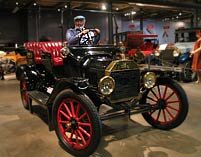
far as we know, this is the only
Renault "Opera Coupe" in existence.
The chassis was built in France, the body was by Quimby,
USA.
Louis Renault made his first car in
1898, in the backyard of his parents' house. It had
a De Dion 273cc engine. Upon receiving orders from
potential customers, he founded Renault Fréres
in Billancourt, Seine with his two brothers Fernand
and Marcel.
Like many automakers of the time in both Europe
and America, Renault built only the chassis, which
was then shipped to private coachbuilders for finishing.
This method was employed well into the '30's.
From 1900, Renault used 500cc De Dion engines. They
then went on to twin-cylinder models such as the 1060cc
8cv and the 4398cc four-cylinder 20cv. Many of the
twin-cylinder Renaults were used as taxis in Paris
and London, and were also the first taxicabs in New
York.
Renault was the first to create enclosed cars, and
also the first to use a drive shaft instead of belts
or chains. Renaults were also among the fastest cars
in 1901-1903, with speeds over 60mph. Renault won
the first Grand Prix run in 1906.
By 1912 Renault Fréres had made 34,000 cars
and offered 15 different models, of which the best
was the six-cylinder 7539cc 40cv. It became the flagship
of the Renault range and would fit coachwork from
the greatest coachbuilders of the period. It was considered
the most elegant vehicle on the road. A new Renault
40 cv model, the type DT, appeared in July 1913, introducing
two three-cylinder blocks instead of three pairs.
This car could reach a top speed of over 100 km/h.
By W.W.I, Renault had become one of the most important
manufacturers of cars in Europe. During the war the
Renault taxis became the legendary "Taxis de
la Marne".
It is reported that a 1912 Renault with a "Town
Car" body (enclosed passenger compartment - open
chauffeur's compartment) was loaded aboard the Titanic
on her maiden voyage.
This car is similar to the car featured in a steamy scene in the movie "Titanic."